Royal Borough of Greenwich · Product Designer · 2024 · 3 months
Redesigning location-based search for the Greenwich Community Directory
A behaviour-led redesign of the Greenwich Community Directory to support the ability to search for services by location.
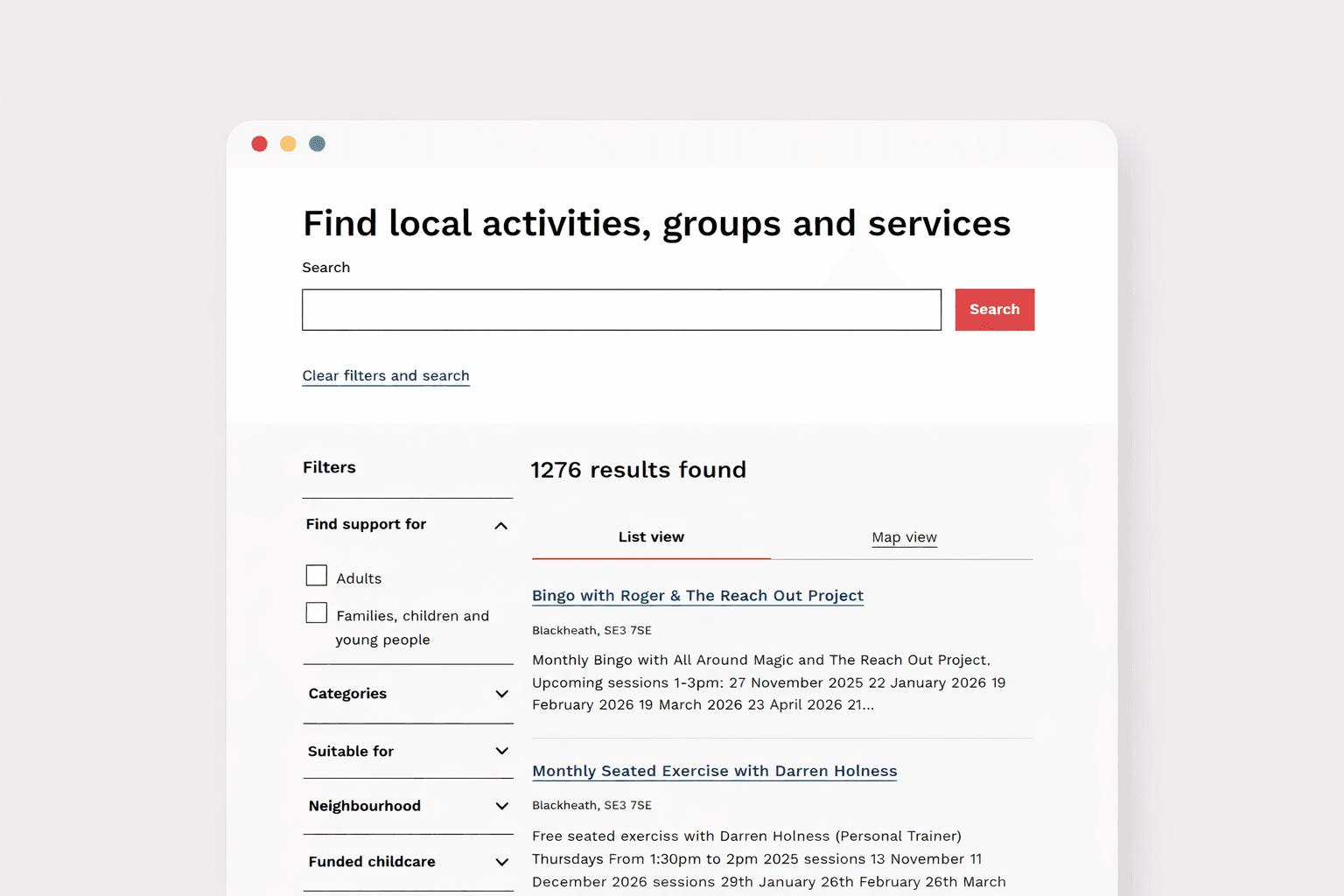
Overview
I led the redesign of location-based search for the Greenwich Community Directory to better reflect how residents actually find services.
Research showed location was a key decision factor, particularly for optional and local activities, yet the directory's location experience was fragmented and difficult to use. Improving this wasn't just a usability fix, but a strategic opportunity to increase trust, relevance, and real-world usefulness.
Problem
Although the directory held a rich database of services, searching by location was confusing and ineffective:
- Users could only browse via a cluttered GIS map
- No way to filter by neighbourhood or area
- Listings didn't clearly show where services were located
- Inconsistent location naming broke users' mental models
As a result, many residents abandoned the directory in favour of Google, losing access to curated local services.
Challenge
How might we help residents find services however they search, whether by service or by location, given messy location data and little room to change the underlying system?
Approach
I took a behaviour-led approach: desk research across councils, user testing to uncover real search patterns, concept exploration with effort-vs-impact prioritisation, and detailed design grounded in delivery feasibility.
Key insight
User research surfaced two primary search behaviours: service-first searchers who struggled to interpret location information, and location-first searchers who explored mainly via the map. The redesign needed to support both.
Solution
Three high-impact improvements
Separate 'List' and 'Map' views
Reduced cognitive load and aligned with distinct search behaviours.
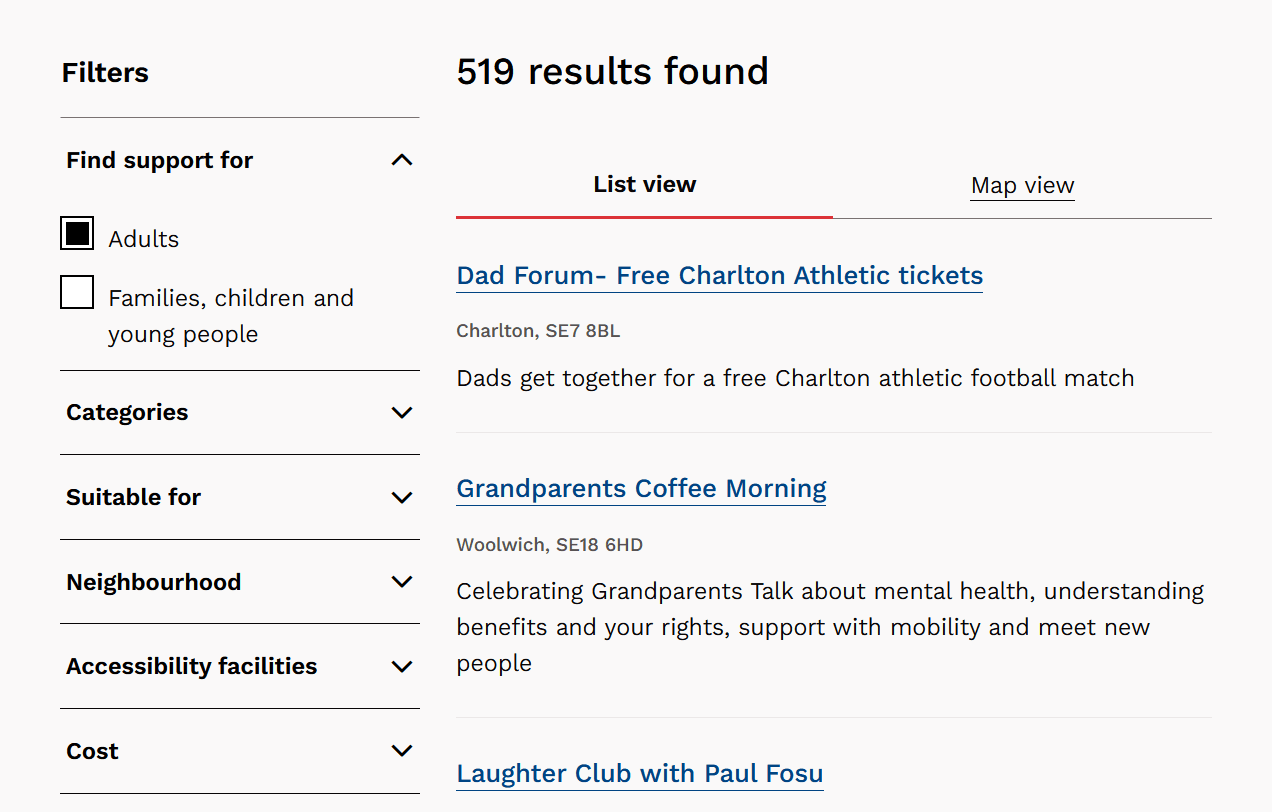
Neighbourhood-based filters
Translated raw postcode data into intuitive, human-readable areas.
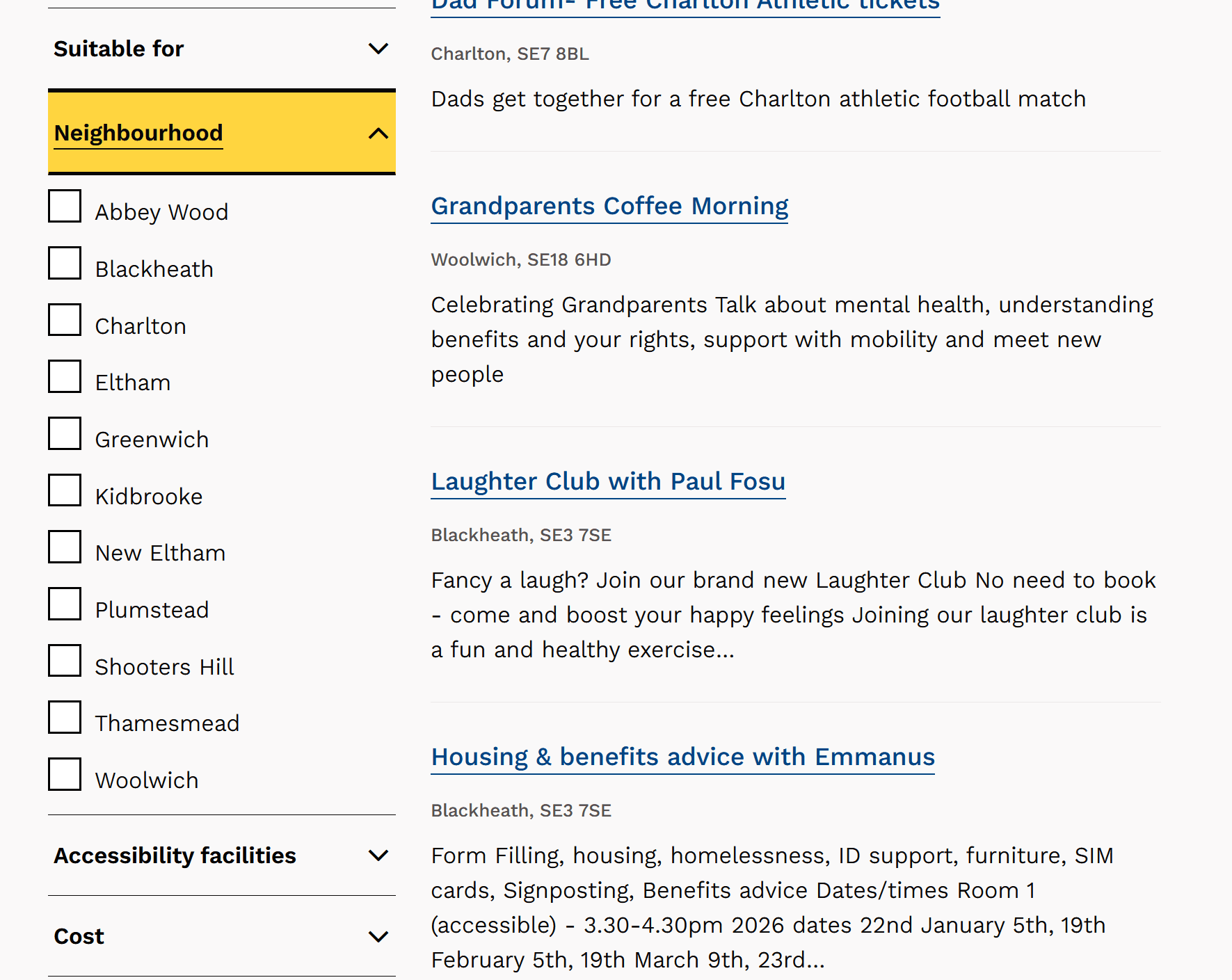
Location tags in listings
Made proximity visible at a glance in results previews.

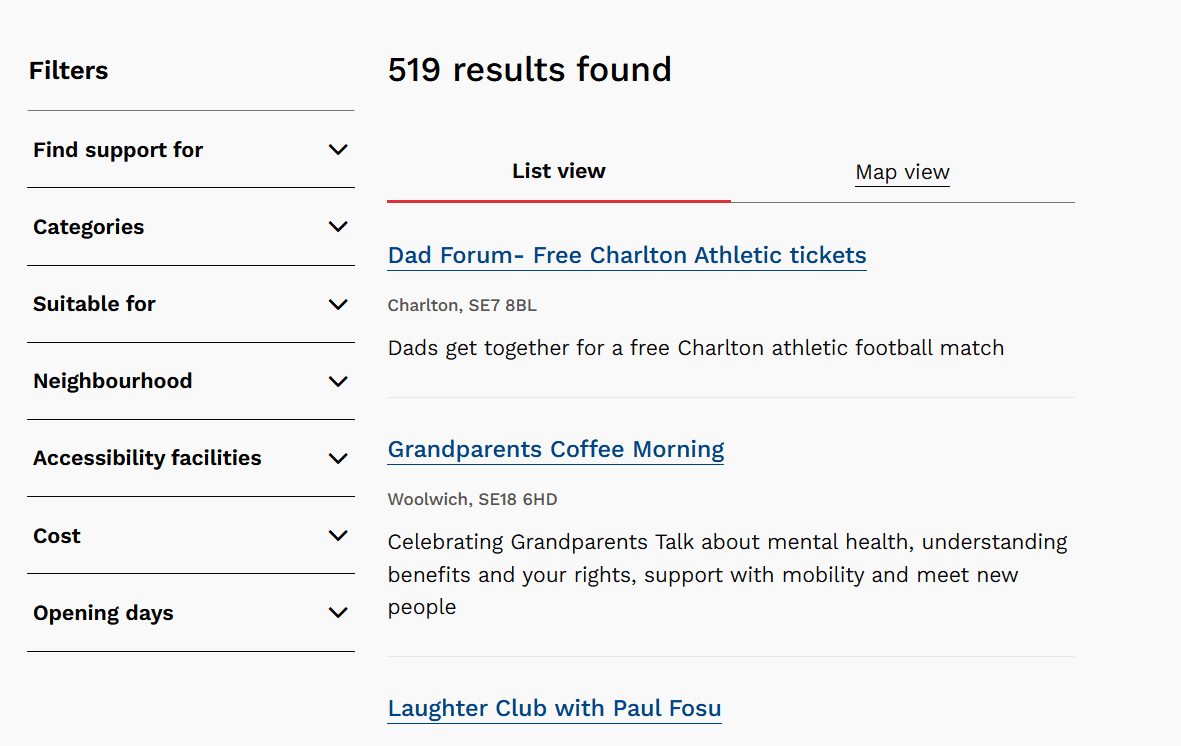
Clearer filter feedback
Moved the result count to the top of the page and enlarged it so users can see the page change after filtering.
Implementing neighbourhood filters
In the CMS, the only required location field for service listings was postcode. An internal database mapped postcodes to regional wards, but raw postcodes weren't meaningful for filtering, and ward names were too granular and unfamiliar to residents.
I defined a more intuitive list of Greenwich neighbourhoods and mapped all service postcodes into these areas, creating a scalable postcode-to-neighbourhood dataset, layering meaningful, human-readable filters on top of existing data without changing the CMS.
Impact
- Made it easier for residents to find nearby services by supporting both service-first and location-first search behaviours.
- Improved usability and trust while reducing friction within real-world technical and delivery constraints.
- Demonstrated behaviour-led design that balanced user needs with system and delivery realities.