Bringing Bloomberg to armchair investors

Overview

Role: UX Designer
Organisation: Tulip
Skills: Prototyping, interviewing, data analysis and synthesis
Deliverables: High-fidelity prototype, design guidelines

For many amateur retail investors, financial statement analysis has been made out to be complicated and technical. However, once equipped with the understanding of what different key numbers mean, reviewing financial statements can become part of a broader and more intuitive process of interpreting a story surrounding a company.

Today, many decision support systems do little to empower amateur investors with interpreting financial information. Instead, these systems are typically designed to simply provide investment recommendations with no feedback on how they were produced, resulting in slow and ineffective learning.


🎯 Project Aims

  • Research the interaction behaviour and rationale of expert financial analysts when interpreting financial statements.
  • Address this behaviour in a prototype designed to support amateur investors.

🛠️ Approach

  1. Understand the interaction behaviour and rationale of expert financial analysts when performing financial statement analysis.
  2. Establish design guidelines.
  3. Create a high-fidelity prototype.
  4. Evaluate the usefulness of the prototype through measuring change in confidence levels.

🗺️ Discovery

After doing some initial desk research to identify an appropriate data collection method, I decided to conduct a series of contextual inquiry interviews due to its emphasis on understanding how experts structure their work. This approach involved interviewing a sample of eight expert financial analysts as they performed financial statement analysis in their natural environment.

Contextual inquiry interviews

To conduct effective contextual inquiry interviews, I adopted a set of principles designed to establish an apprentice–master dynamic. In this relationship, I positioned myself as the learner and the expert analyst as the practitioner. This approach enabled me to ask informed, probing questions and gain a deeper understanding of how analysts approach financial statement analysis.

  • Context: Capture an ongoing experience rather than summary experience and concrete data as opposed to abstract data.
  • Partnership: Collaborate with the participant to develop a shared understanding of the work.
  • Interpretation: Infer possible designs which can support the participant’s work structure.
  • Focus: Have a clear interview framework to steer the conversation towards data that is relevant for the study.
A screenshot from a Zoom video call between the researcher and a financial analyst looking at a financial statement.

Thematic analysis

Using a thematic analysis approach, I synthesised a list of themes from the data by following a six-step process:

  1. Transcribed the data using Dovetail.
  2. Generated initial codes relating to interesting features of the data.
  3. Collated codes into potential themes.
  4. Reviewed the themes by looking at the underlying data and checked that the themes made sense in relation to the coded extracts.
  5. Defined and named the themes to help tell the overall story of the analysis.
  6. Produced a report by selecting compelling and vivid extract examples.

Establishing design guidelines

Based on the themes synthesised from the data analysis, I created the following design guidelines to inform the design of the prototype:

  1. Support users in framing and reframing a company’s financial information.
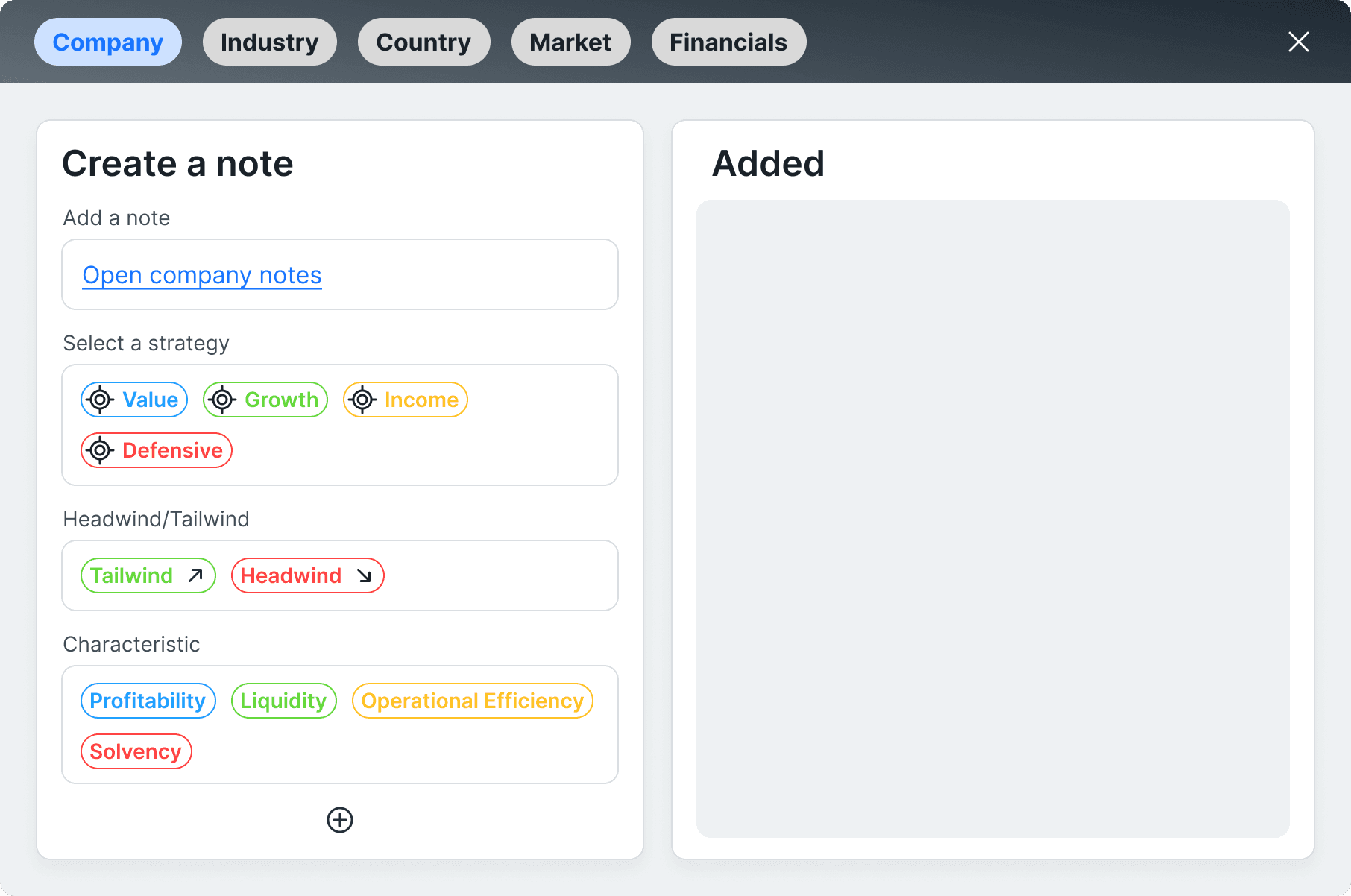
  2. Support users in developing and applying an investment strategy.
  3. Support users in acquiring a company’s contextual information.
  4. Support users in developing and applying their intuitive tacit knowledge.
  5. Support users in applying a variety of analytical techniques.
  6. Support users in referencing a variety of information resources.

🧪 Prototyping a proof of concept

I started the design phase with a focus on ‘getting the right design’, sketching a variety of conceptual designs that showcased the design guidelines in different ways. Then, with a clearer idea of how the product would look and feel, I moved my focus towards ‘getting the design right’, designing a high-fidelity production-ready prototype.

Creating a simple design system

To ensure consistency in the visual design of the prototype, I created a design library in Figma which incorporated guides for colour, typography and grids along with a range of reusable functional components.

Using Disney in the proof of concept

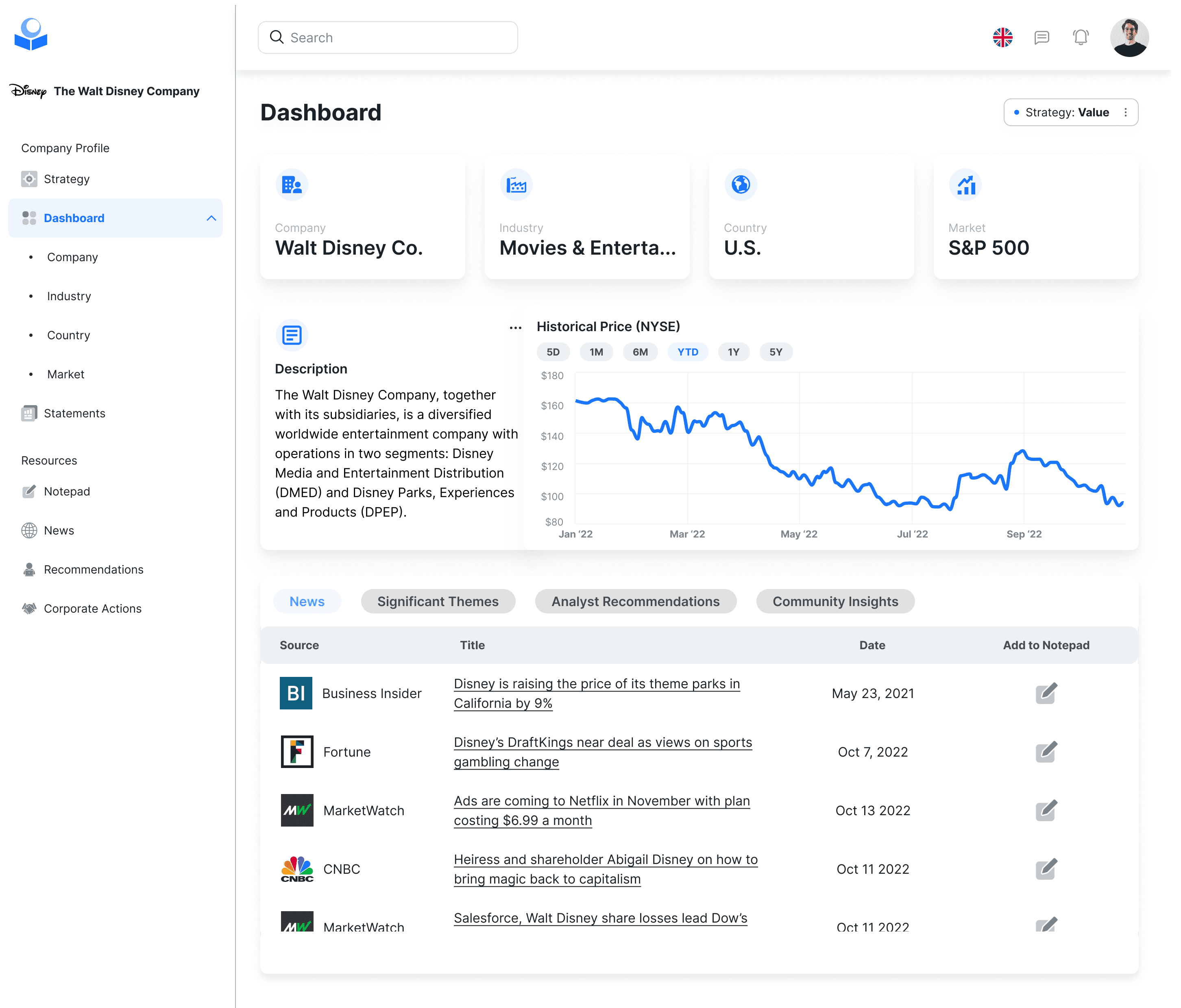
I used Disney as a use case in the prototype because its broad business structure gives plenty of room for amateur investors to use the breadth of the features on the prototype and in turn, hopefully developing a more nuanced and refined story of the company.


Prototype showcase

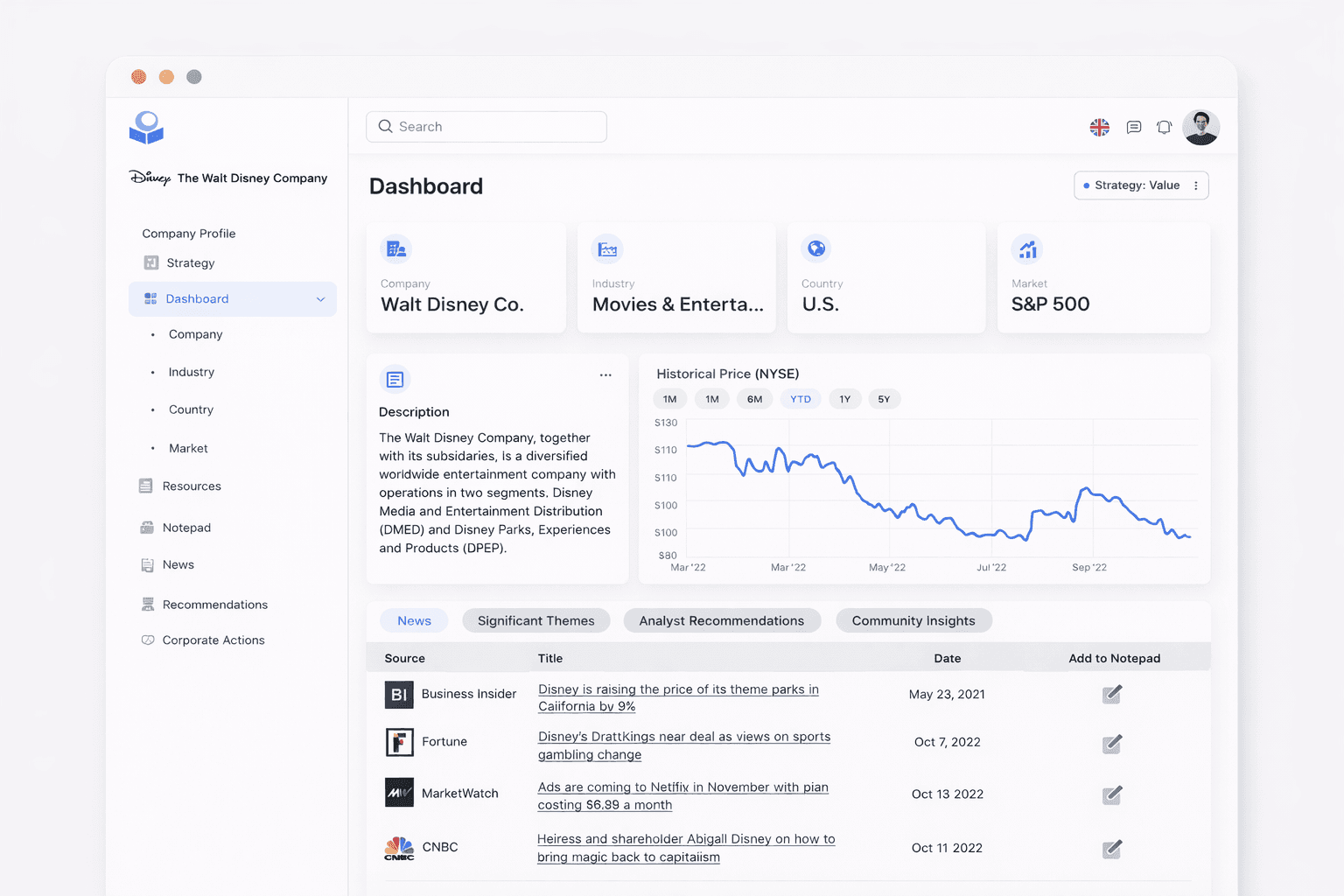
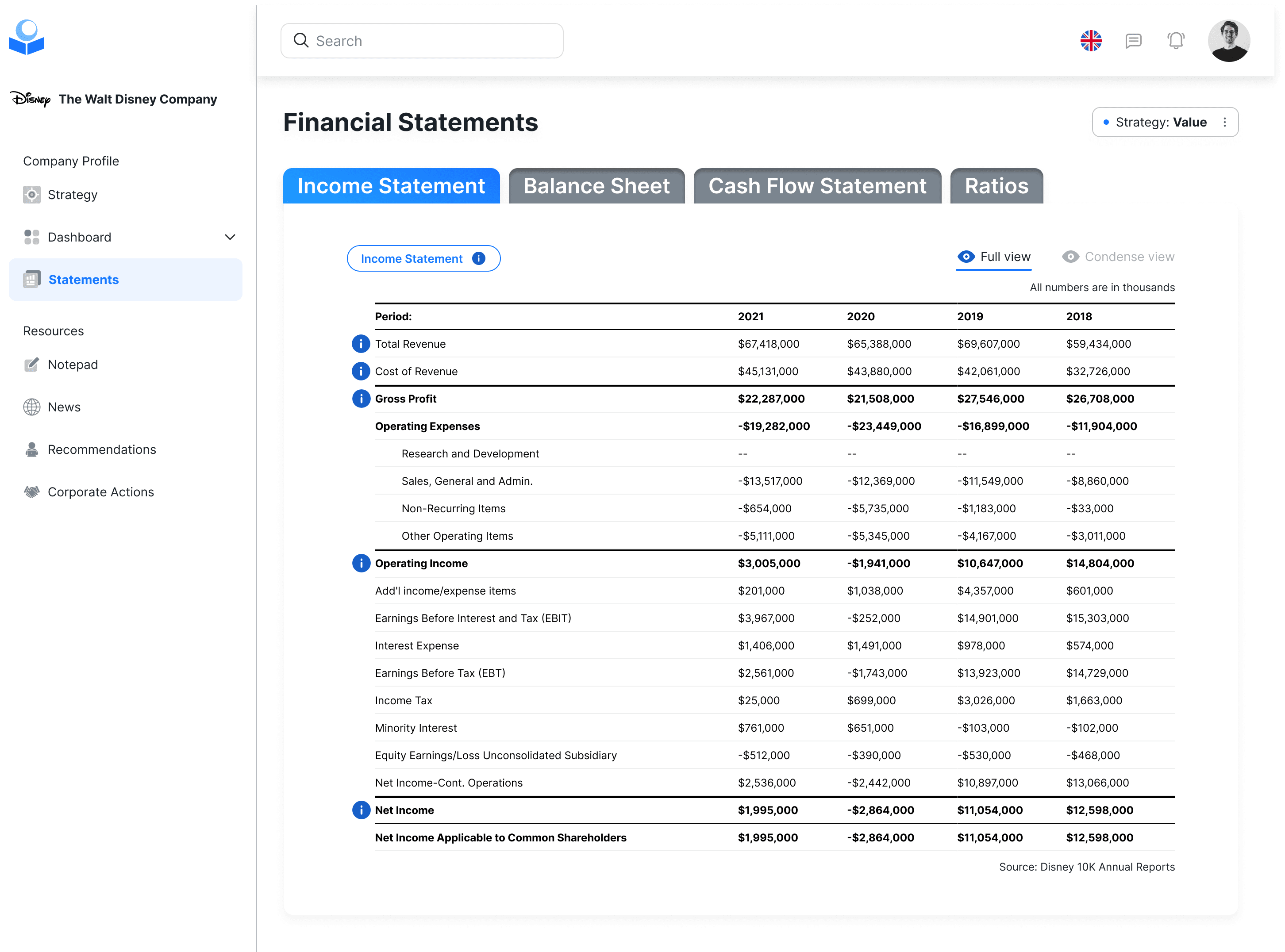
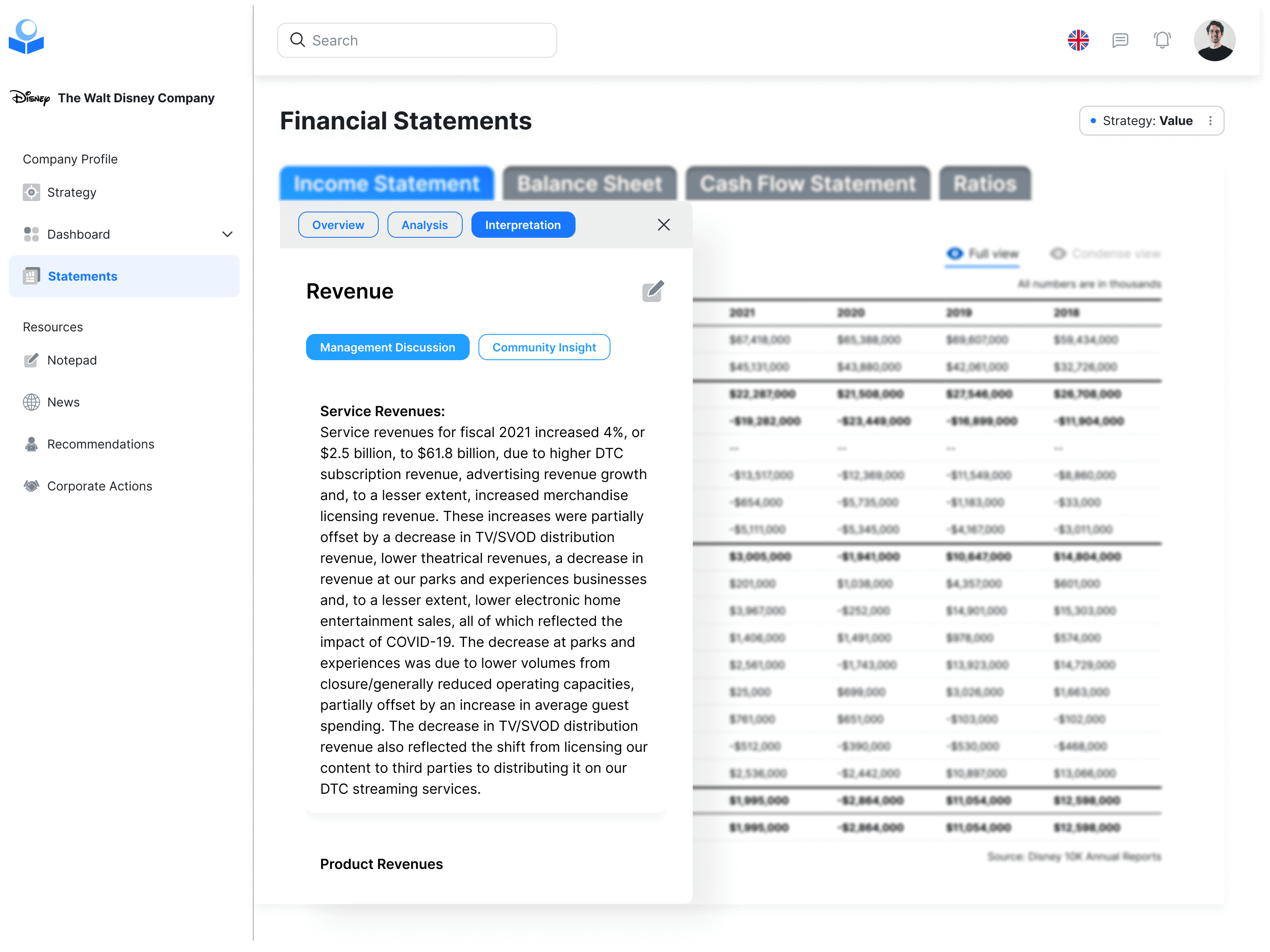
After conducting thorough research into the interaction behaviour and rationale of expert investors, I designed a prototype that leverages these insights with the goal of empowering amateur investors to make more informed investment decisions.

Setting up a strategic framework to support focused analysis

The strategy page is the first page that the user sees after selecting a company to analyse, prompting them to consider their personal investment objectives and establish an investment strategy before engaging in any analysis.
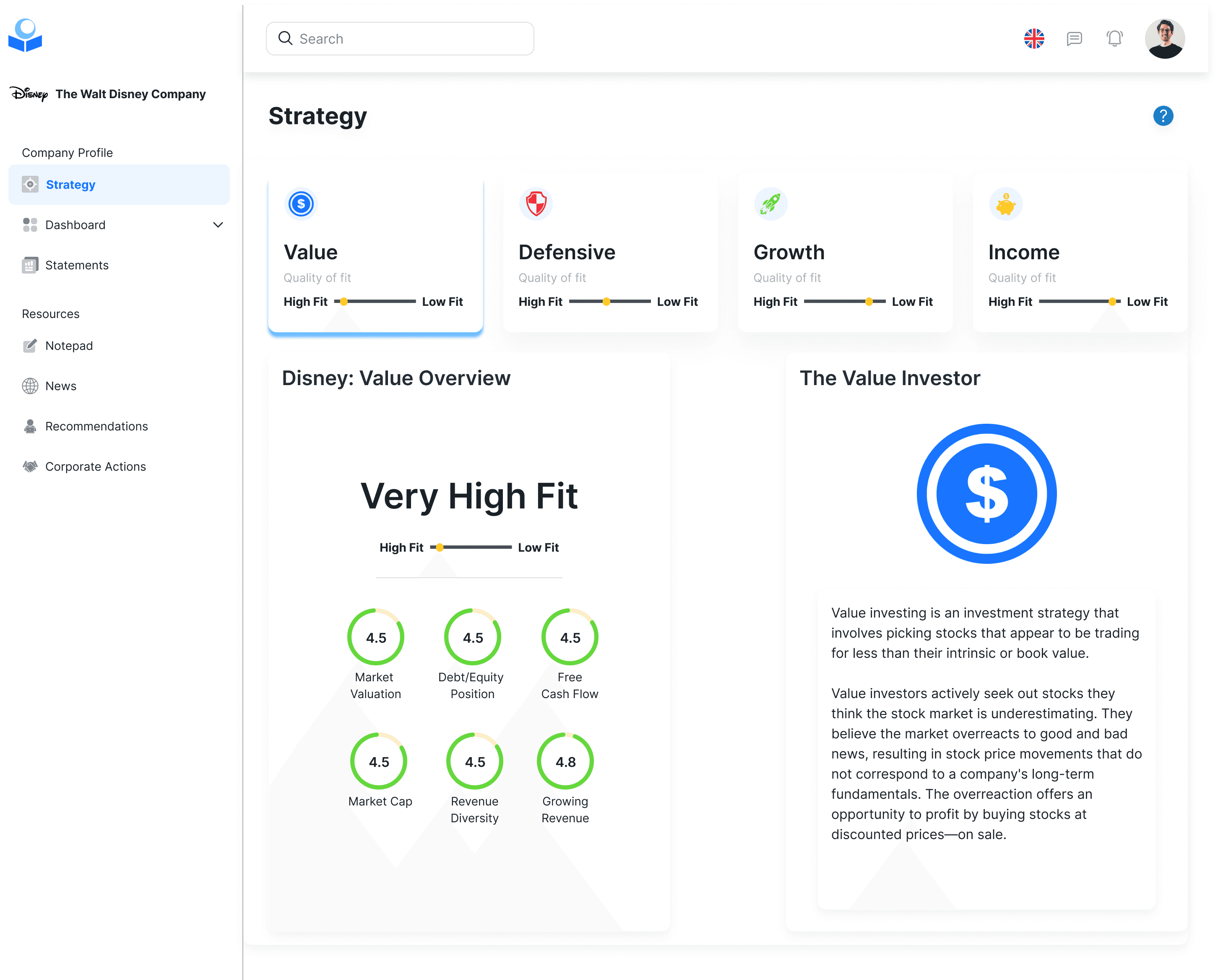
A dashboard user interface showing an investment strategy setup page allowing the user to understand the different investment strategies available to them and select one to help their analysis going forward.

📊 Evaluation

The goal of the evaluation was to measure the usefulness of the prototype in supporting amateur investors with interpreting financial statements to make an informed investment decision.

To achieve this goal, I decided to conduct a series of 8 remote moderated user tests.

Evaluation questions

  • What was the overall change in confidence levels towards performing financial statement analysis?
  • Was this change statistically significant?
  • What was the change in confidence levels for each participant?

User testing approach

  • Pre- and post-test likert scale questionnaire designed to measure change in confidence levels.
  • Naturalistic observations with think-aloud approach.

Change in confidence levels

Across the entire sample of participants, there was an increase in average confidence levels in interpreting financial statements after using the prototype from a neutral confidence level to a high confidence level. I also performed some statistical analysis on the results and found that this change in confidence levels was statistically significant.

On a more granular level, all participants experienced an increase in confidence levels in interpreting financial statements after using the prototype.

A bar chart showing the change in confidence levels towards financial statement analysis from before the test to after

📌 Summary

  • Expert analysts were found to conduct financial statement analysis in an intuitive manner of framing and reframing a company’s information to make an informed investment decision.
  • Based on these findings and the findings of related literature, I established a set of six design guidelines to inform the design of a prototype.
  • By showing a statistically significant increase in the confidence levels of amateur investors after using the prototype, the evaluation revealed that these guidelines are useful in supporting amateur investors with interpreting financial statements.